SOURCE: Interactive Book Prototype
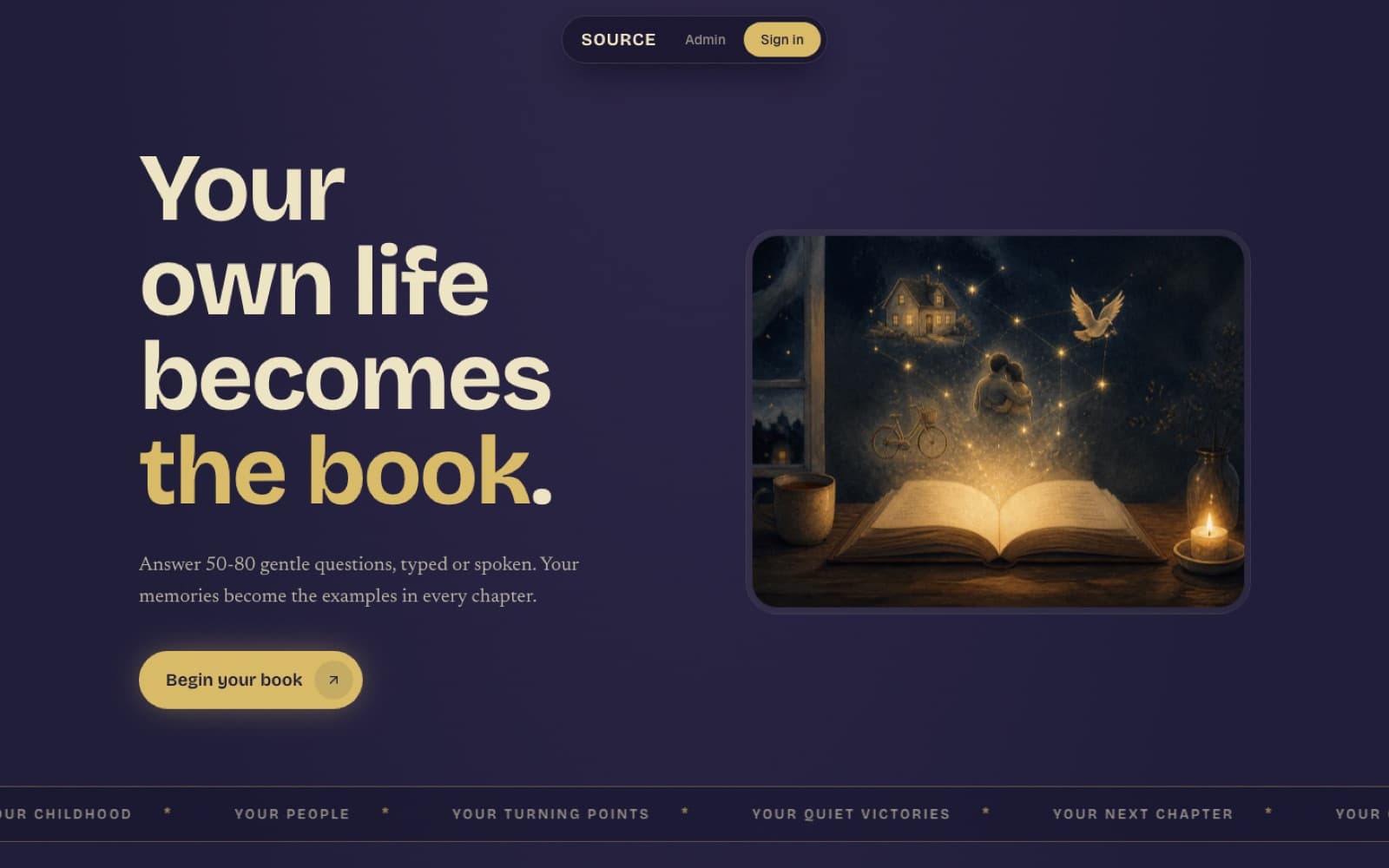
Readers answer a guided questionnaire, typed or spoken, and receive a personalized 4-chapter illustrated storybook, with a separate executive dashboard.
Team of one· Solo designer & engineer
No team, no agency, no hand-offs. I owned this project end to end:
- Requirements
- Architecture
- UI & UX
- Stack
- Next.js 15Tailwind v4Web Speech APIshadcn/uiRecharts
What was broken, and what fixed it
Problem: The client needed to test the product idea with real readers before building a backend.
Fix: A backend-free V1 keeps reader data in browser storage, so the questionnaire, the 4-chapter storybook, and the executive dashboard all run at a public URL with zero setup.
Problem: Answering many questions in one sitting is a lot to ask, so progress had to save.
Fix: 24 questions, typed or spoken, fit a session of about 20 minutes. Every keystroke autosaves, and login resumes at the first unanswered question.
Approach
- Backend-free V1 using browser storage, so the full experience can be tested with zero setup.
- Book generation sits behind one function, so it can be swapped for an LLM call without UI changes.
- 24 questions, a representative subset of the planned 50 to 80, so a test session fits in about 20 minutes.
- Print-to-PDF doubles as "download your book".
What I built
- 24-question questionnaire with voice input via the Web Speech API
- Autosave on every keystroke and resume at the first unanswered question
- 4-chapter storybook reader with print-to-PDF; the reader titles the final chapter
- Dark-mode executive dashboard with KPI cards, funnels, and live reader data
- Custom "Crayon Storybook" design system
Architecture
Interface
- Next.js 15
- Tailwind v4
- Web Speech API
- shadcn/ui
- Recharts
Infrastructure & delivery
- CI
- 1Next.jsTailwindCI
Next.js 15 app with Tailwind v4, exported as a static site and deployed to GitHub Pages by GitHub Actions.
- 2
All reader data lives in browser storage behind one store module, so a real database only touches that file.
- 3
One generator function turns the answers into a typed book object that the reader renders.
- 4shadcn/uiCharts
A separate admin dashboard built with shadcn/ui and Recharts reads live reader data from the browser.
Engineering
- Book generation is deterministic now and designed so an LLM call can replace one function with no UI changes.
- Every keystroke autosaves, and login resumes at the first unanswered question.
- Layouts were checked at phone width.
- Known V1 limits are documented: data lives in one browser and local passwords are not production-grade.
Outcome
- A working end-to-end prototype at a public URL, testable with no backend.