AI-Assisted Refund Automation
An LLM reads the messy cases and explains them in plain Taglish, while deterministic rules and a human keep sole authority over money.
Automates a utility's daily refund and payment-correction approval queue across two legacy systems. Deterministic recipes decide, Claude explains the flagged cases, and a human confirms every action.
- The queue had a 76-item backlog when the project started
- 538 pytest tests across the pipeline, recipes, API, auth, and reports
- 7 request types, each its own recipe module
- Spans two legacy systems with no API: a workflow app and the billing and collections system
A manual daily approval queue becomes dry-run, AI-explained, human-confirmed actions
Team of one· Solo architect & engineer
No team, no agency, no hand-offs. I owned this project end to end:
- Requirements
- Architecture
- AI & prompts
- Backend & APIs
- Database
- Stack
- Claude (headless)PythonFastAPIMS SQL ServerHuman-in-the-Loop
Where AI does the work: Claude reads each flagged case read-only, explains what went wrong in plain Taglish, and suggests the fix, while deterministic rules and a human make every decision.
What was broken, and what fixed it
Screens show demo data; client data stays private.
Problem: Every refund or correction meant reading the request, checking the receipt against the ledger in one system, fixing the ledger by hand, then approving in another.
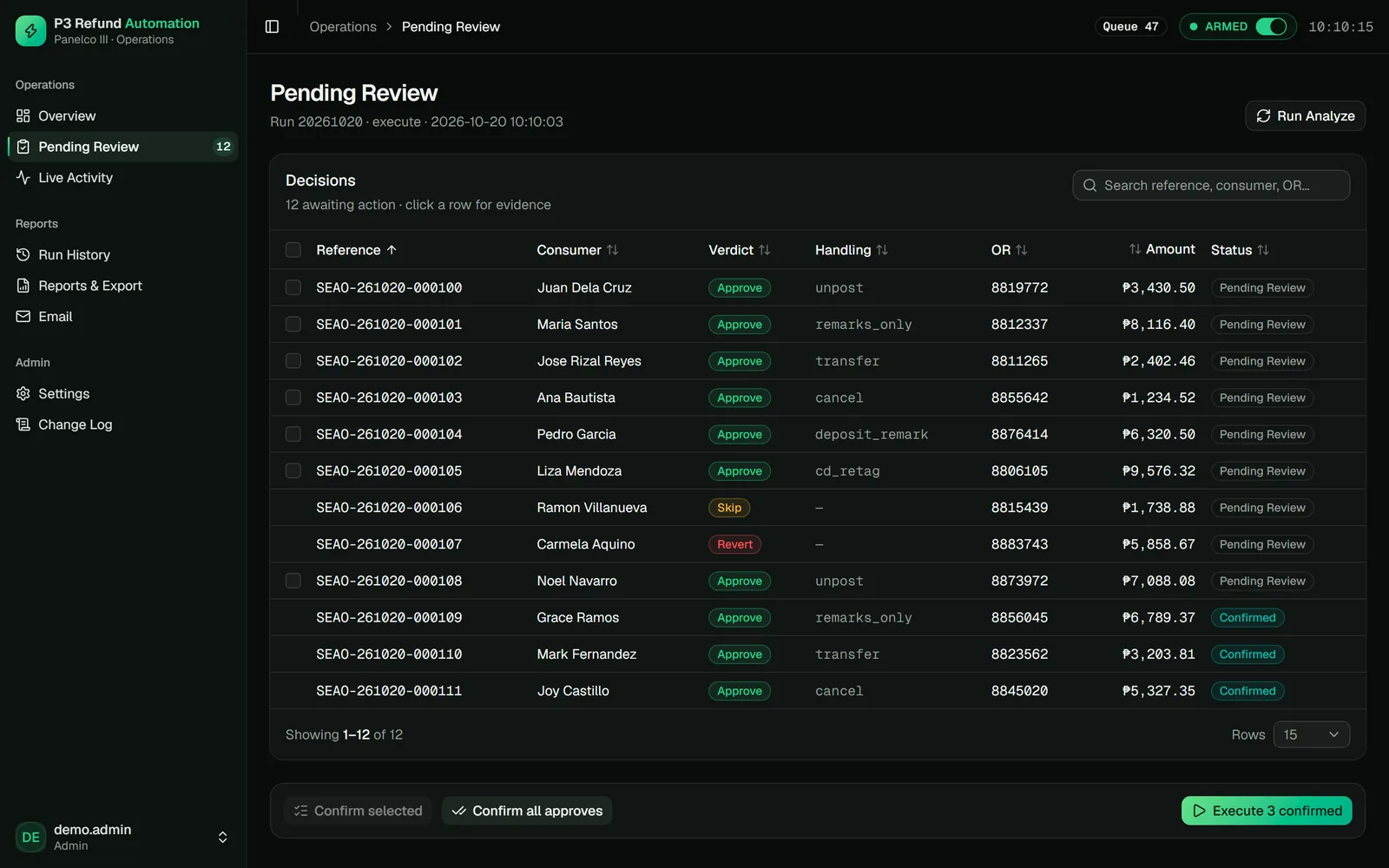
Fix: A daily analyze run pulls the live queue, matches each request to its ledger rows, and returns approve, skip, or revert with a reason. Approval needs the receipt number, date, and amount to all match.
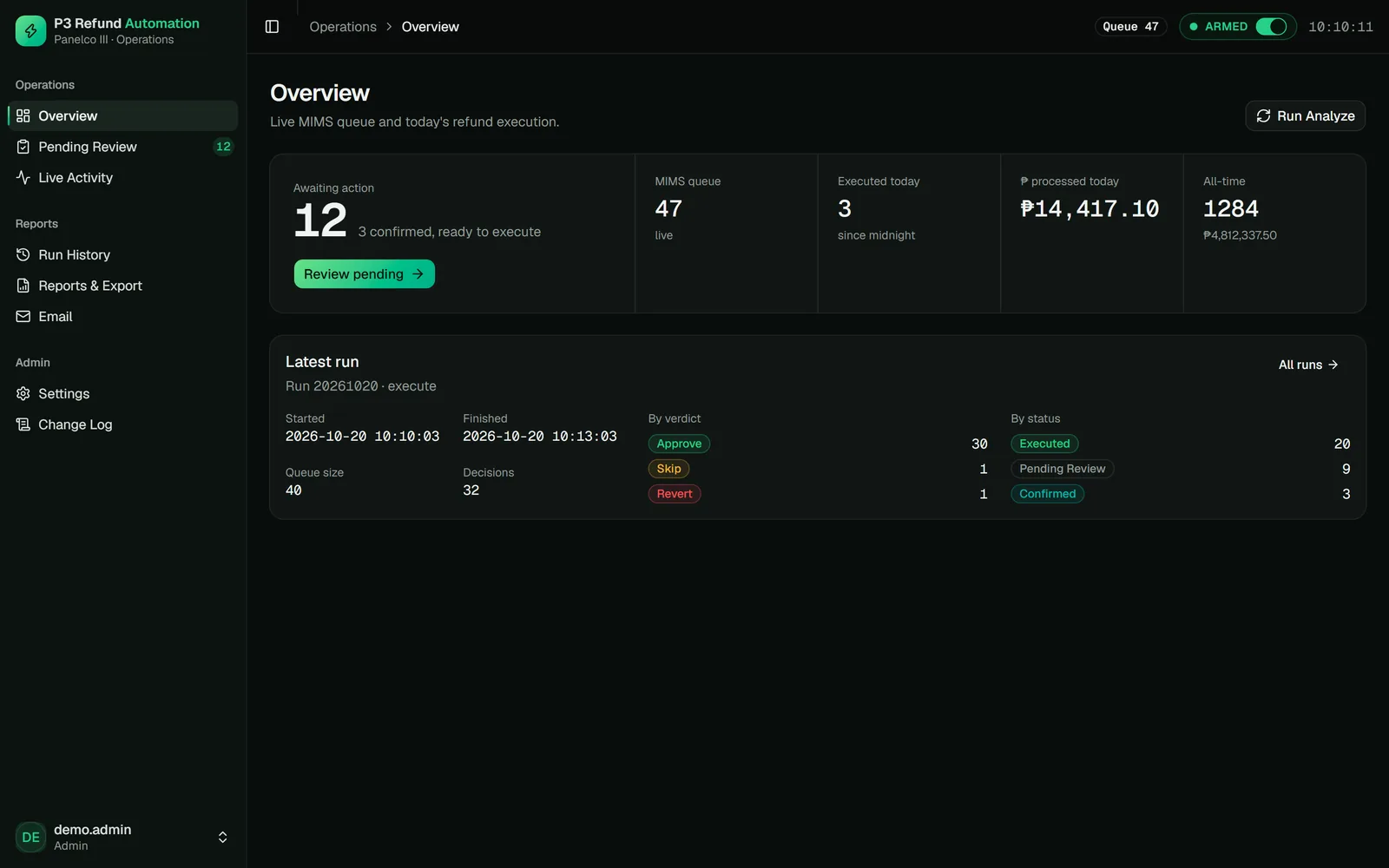
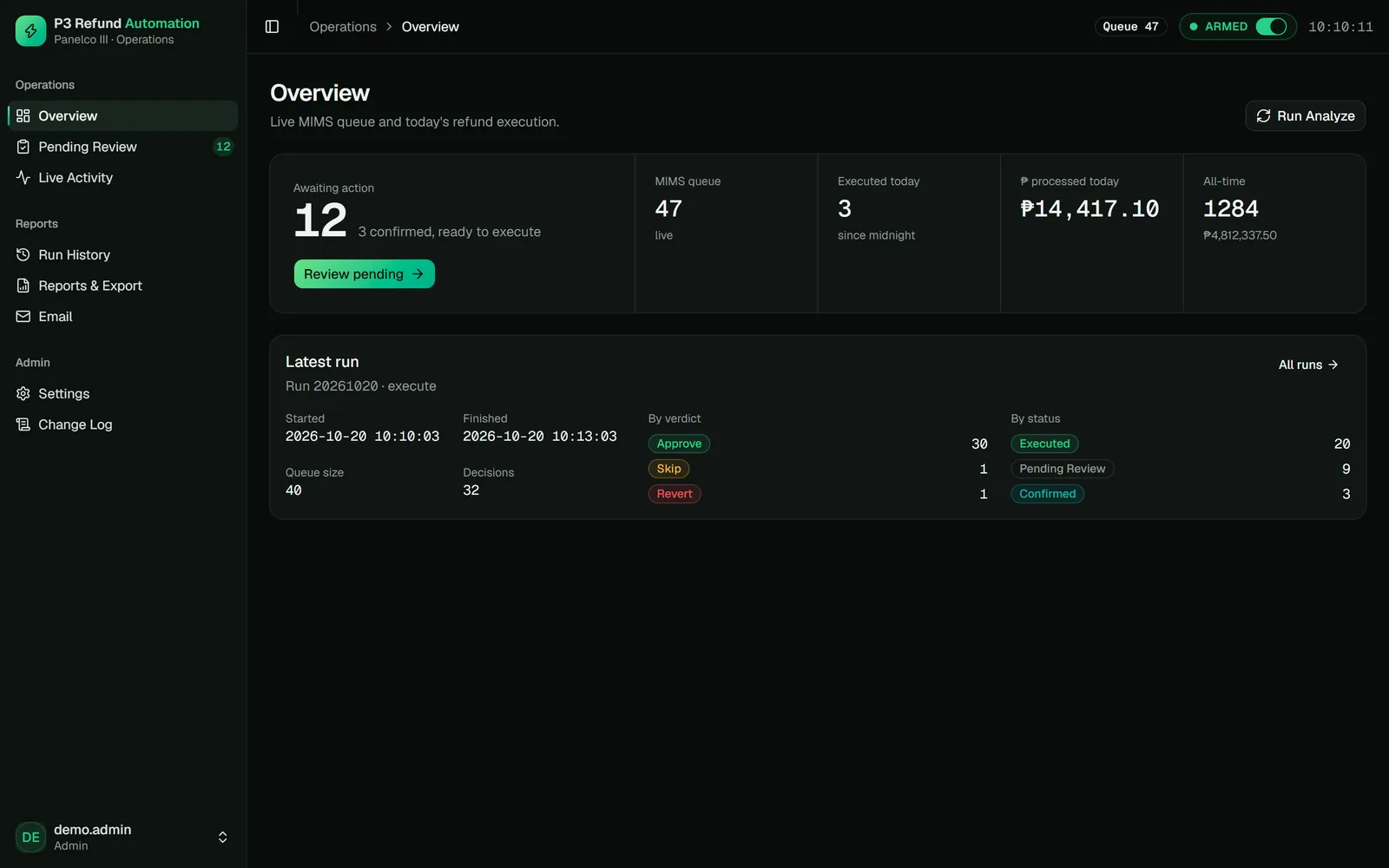
Overview: what is awaiting action, the live queue, and the latest analyze/execute run. Problem: Each manual step was a chance to post money to the wrong account.
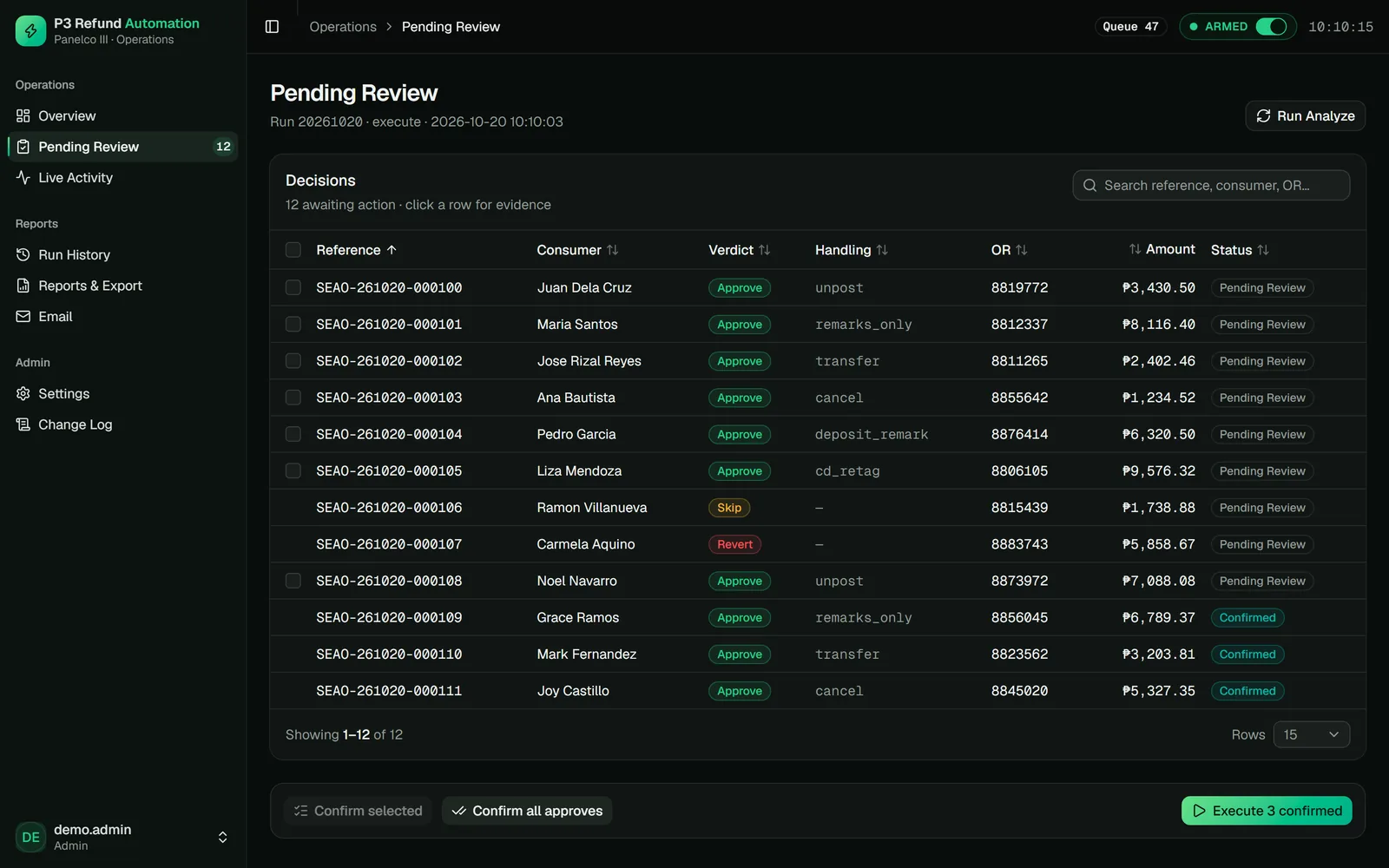
Fix: Nothing touches the ledger until a person confirms. Each execute re-checks live state, skips anything stale, writes in one transaction, and saves a reverse script.
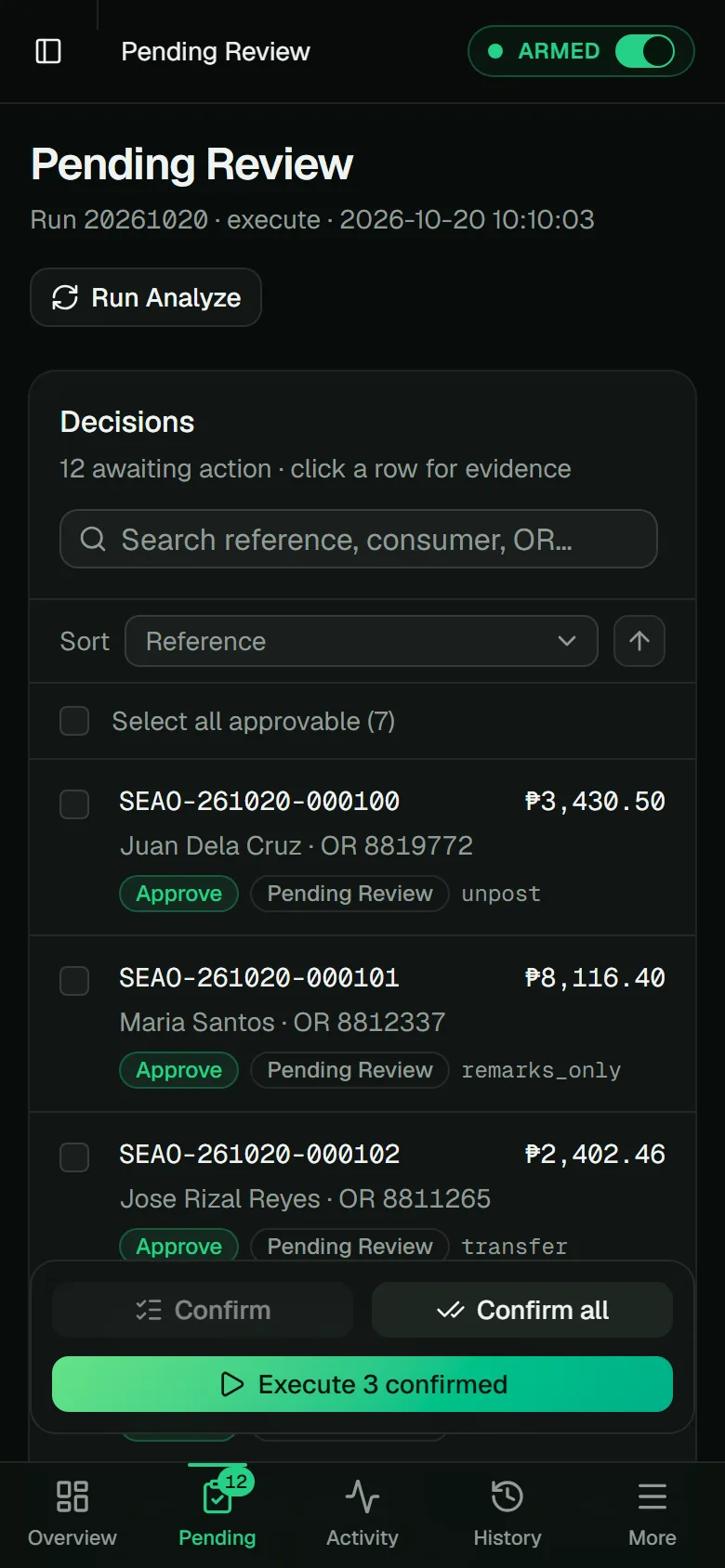
Pending review: every refund request with its verdict and planned handling, confirmed by a person before anything runs. 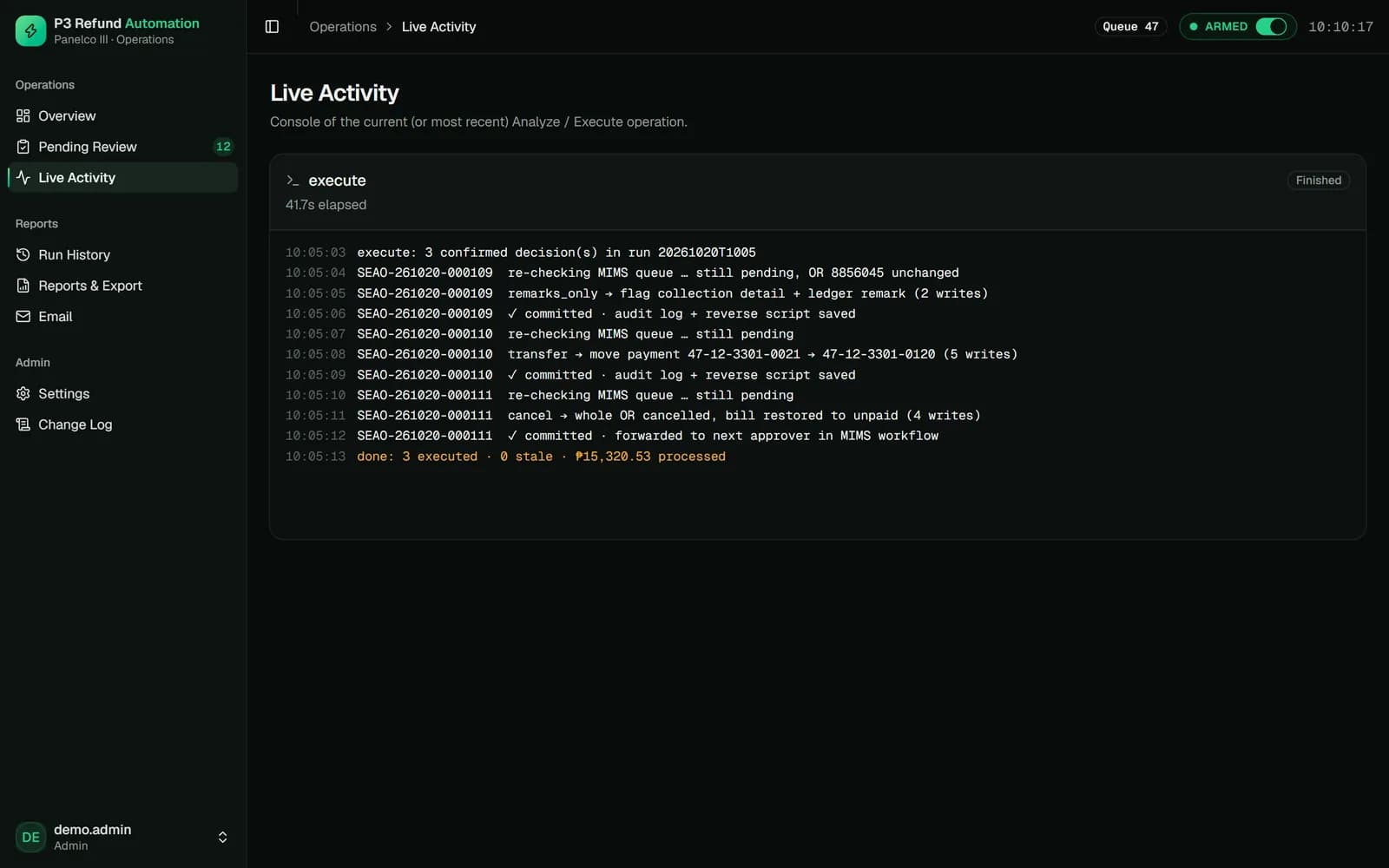
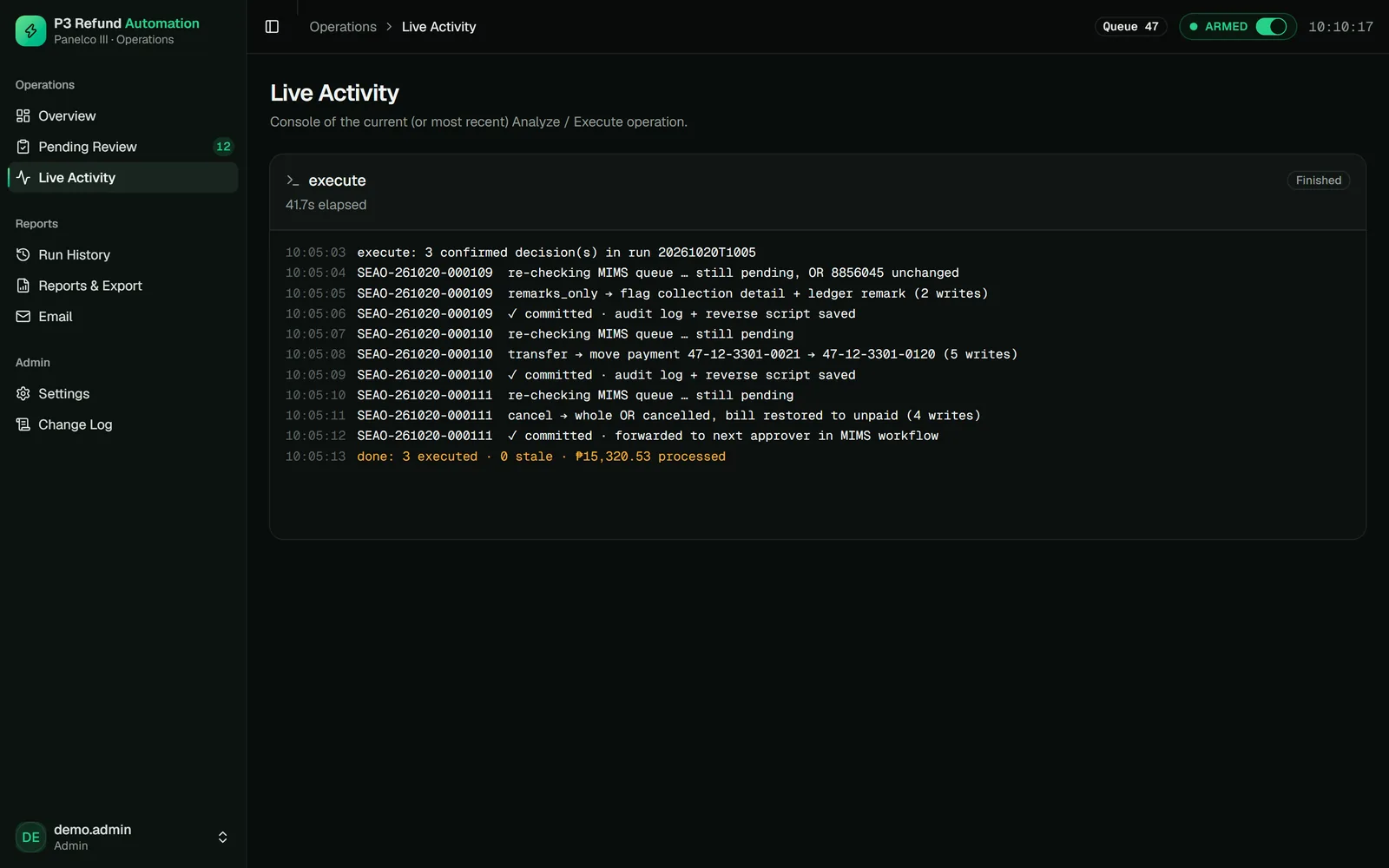
Live activity console: each executed item re-checked, committed with an audit log, and a reverse script saved. 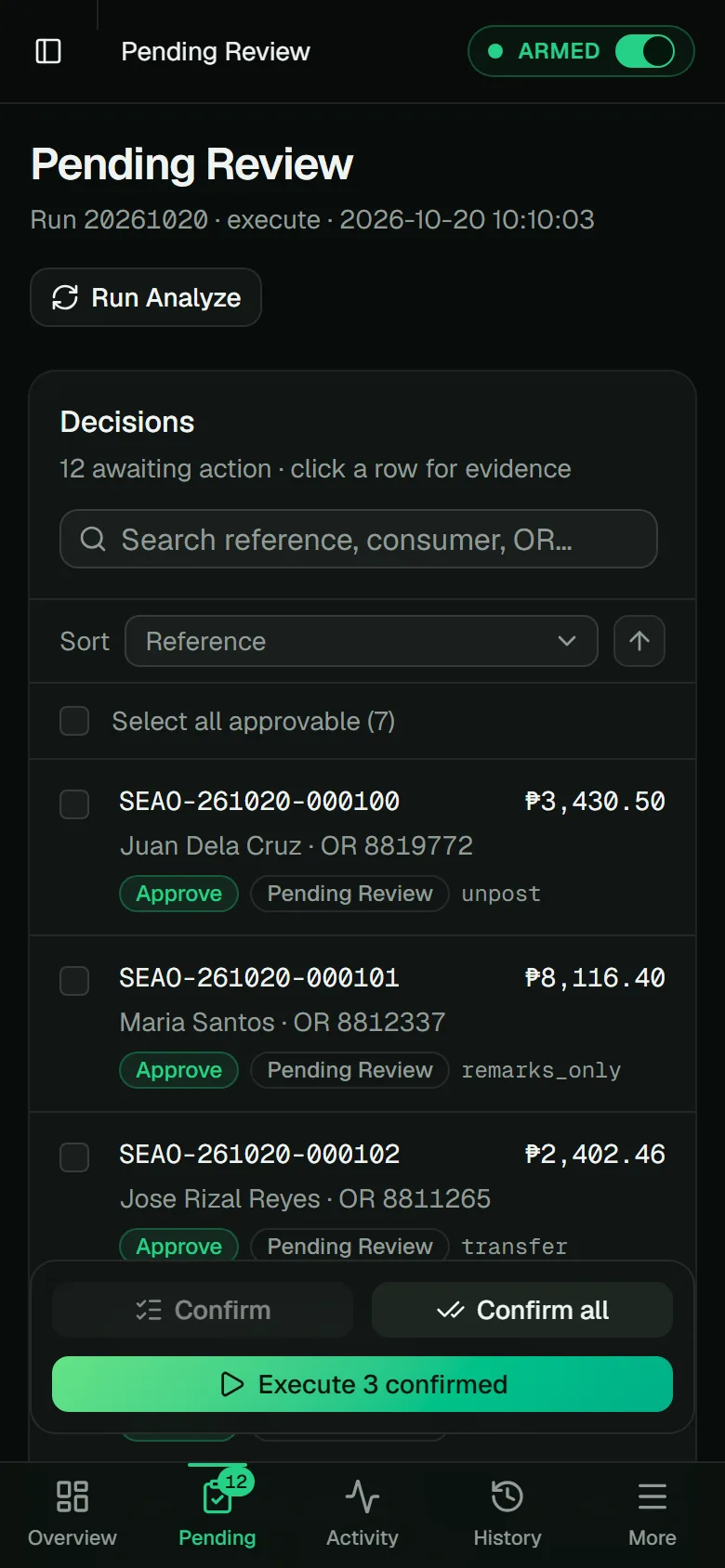
The review queue on a phone, with confirm and execute actions. Problem: Unusual cases sat in the queue with no explanation of what was wrong.
Fix: Claude reads each flagged case with read-only tools and returns a short Taglish explanation, a suggested field fix, and a confidence. It never writes or approves; the rules re-decide with the fix and a person confirms.
Problem: A change to someone's money has to be traceable and reversible after the fact.
Fix: Every run is logged with its verdict mix, every executed change has an audit record and a reverse script, and accomplishment reports go out by email as PDF, Word, Excel, or CSV.
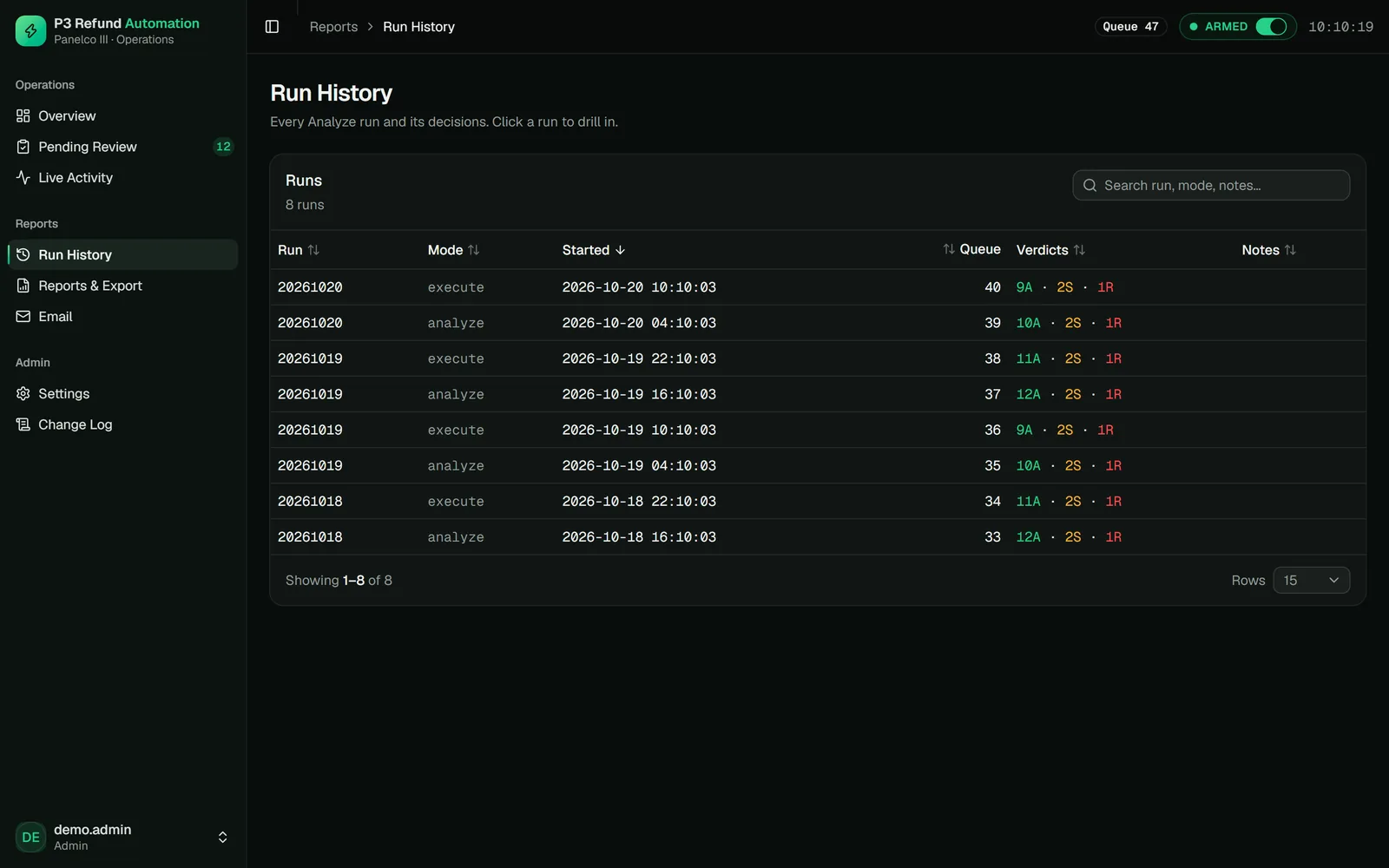
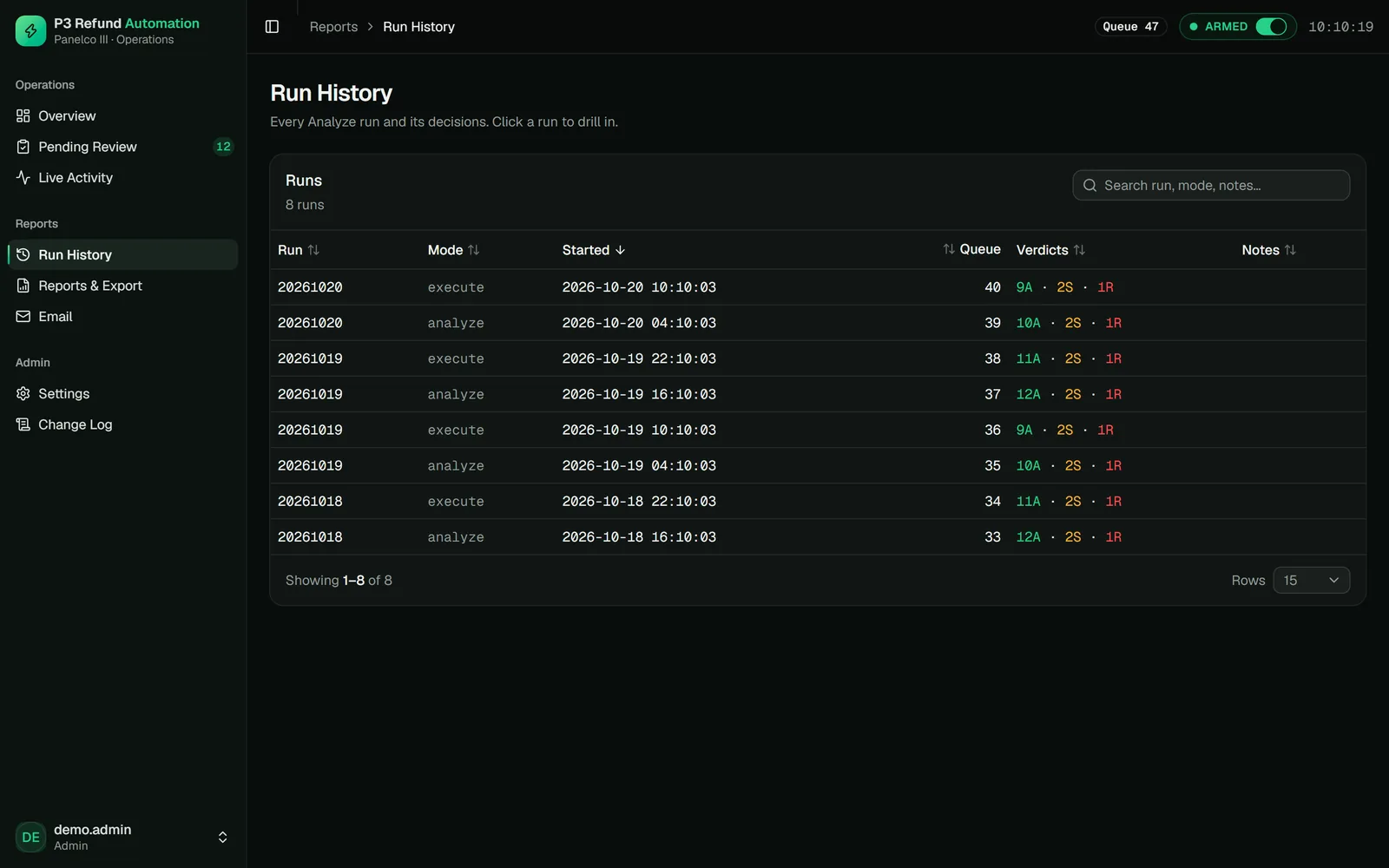
Run history: every analyze and execute run with its verdict mix, for a complete audit trail. 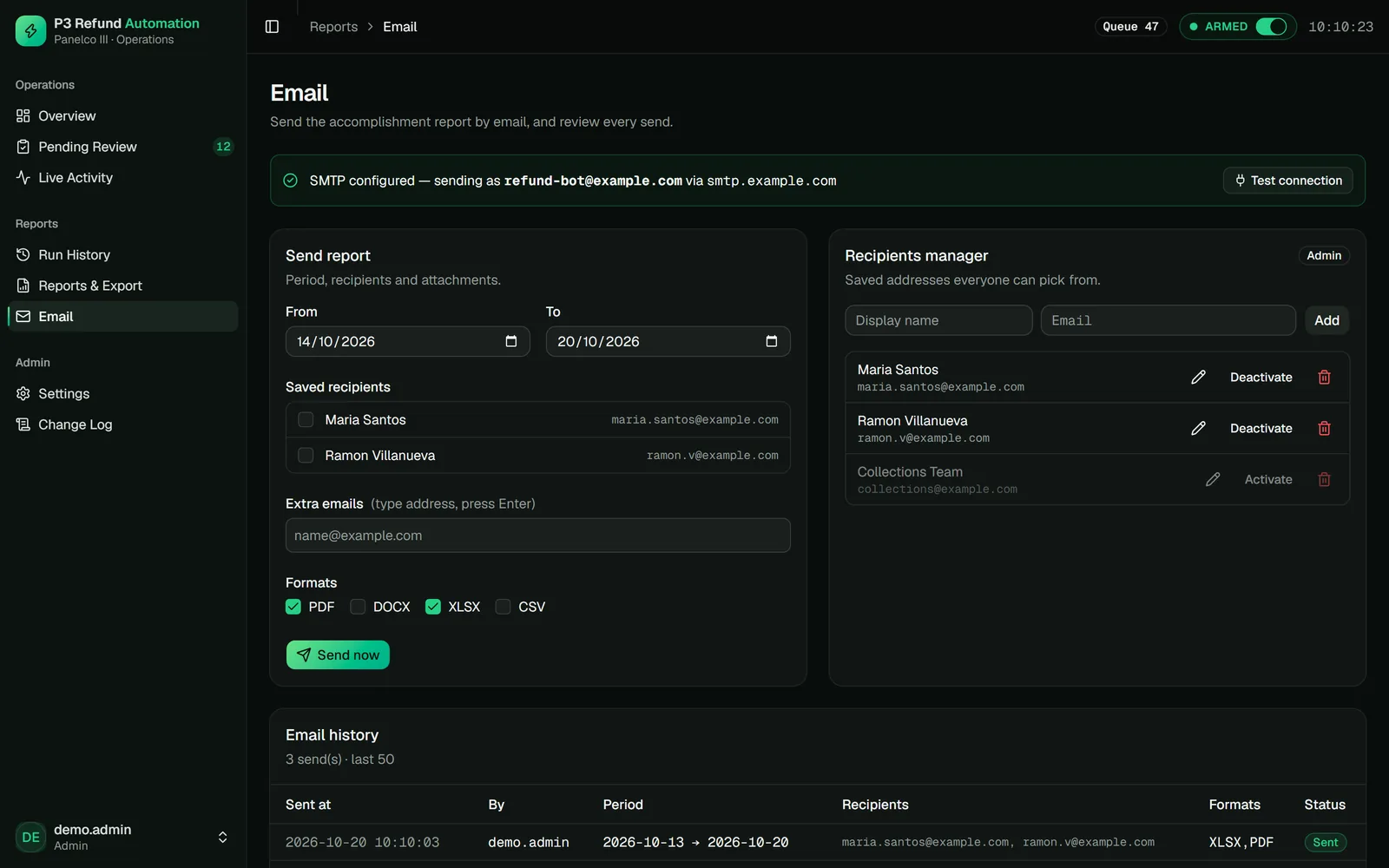
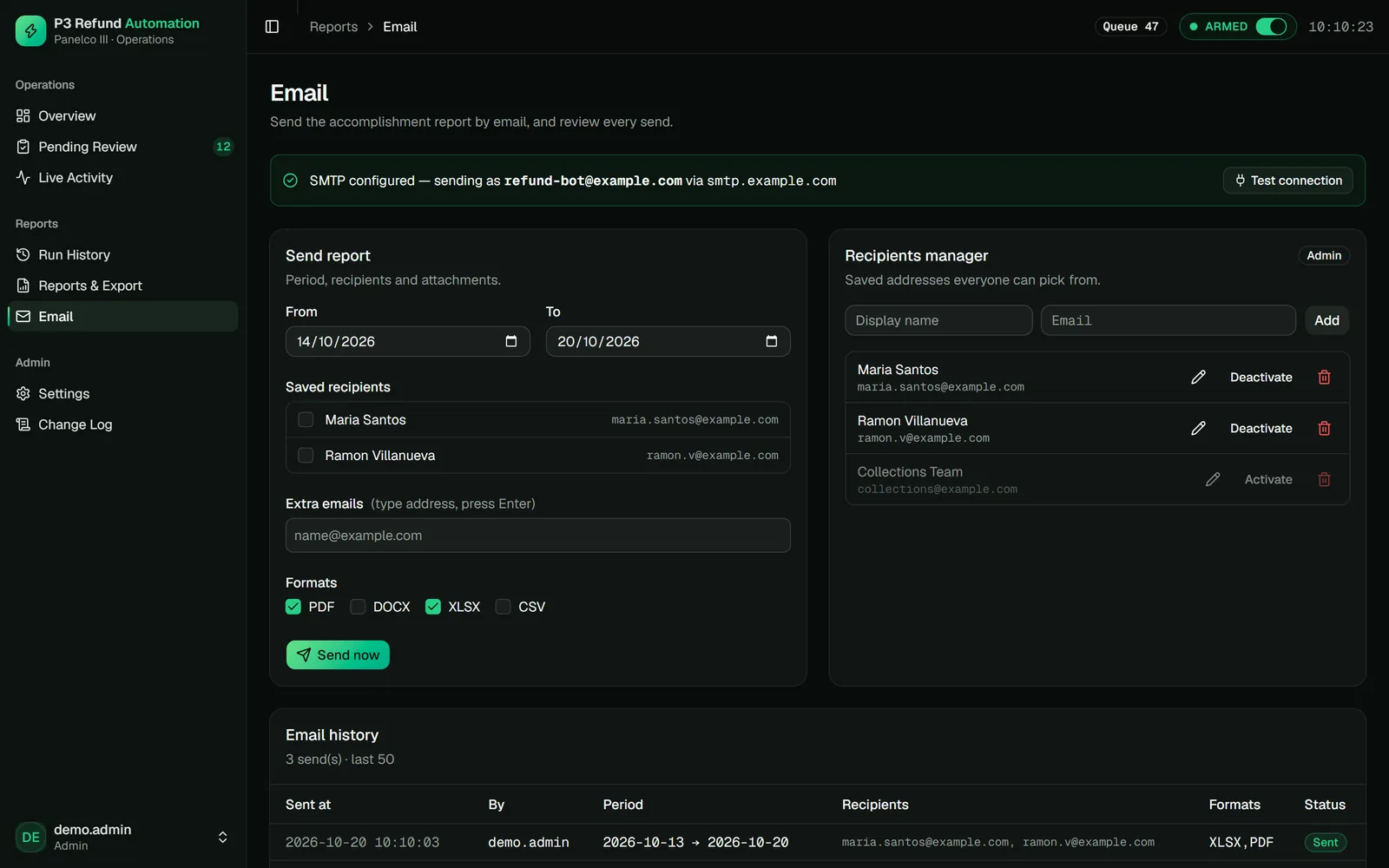
Email reports: accomplishment reports sent to saved recipients in PDF, Word, Excel, or CSV.
Approach
- Staged autonomy: analyze, decide, human confirm, then execute. Nothing touches the ledger without the confirm gate.
- Approvals need positive evidence: receipt number, date, and amount must all match the ledger rows.
- The AI is advisory only. It runs with read-only tools, answers in a fixed JSON schema, and never writes or approves.
- AI notes are cached per case and capped per run, and an AI failure never fails the batch.
What it does
Pipeline
- Analyze: pulls the live approver queue and enriches each request with the ledger rows it refers to
- Decide: a recipe per request type returns approve (with an exact ledger plan), skip, or revert
- Confirm: a person reviews the evidence before anything runs
- Execute: re-checks live state, skips anything stale, writes in one transaction, and forwards the item to the next approver
AI analyst
- Headless Claude session per flagged item, read-only tools, fixed JSON schema
- Category, a 2 to 4 sentence Taglish explanation, a suggested field fix, the closest recipe, next action, and confidence
- Reads the requester's remarks and the full approval trail, and lists conflicts between remarks and records
- Recommends an execute path, or one yes/no question whose answer would automate the whole class of case
Plan and Execute with AI
- A suggested field fix becomes an in-memory override; the source record is never edited
- The same deterministic handler re-decides with the corrected input and shows the exact planned writes
- Executes only if the rules now approve, through the standard executor with a reverse script
Request types
- Standard refund and deposit refund
- Wrong-account correction and intended-month posting
- Receipt cancellation and collection-detail re-tag
- Details-list actions
Safety and audit
- Per-run item and peso caps
- Stale-state re-check before every write
- Full SQL audit trail and auto-generated reverse scripts
- Kill switch (an ARMED toggle)
Dashboard and reports
- Overview, pending review, live activity console, and run history
- Reports in PDF, Word, Excel, or CSV, emailed to saved recipients
- Responsive down to phone width
Architecture
Interface
- React
- Charts
AI
- Claude (headless)
- Human-in-the-Loop
Logic & APIs
- Python
- FastAPI
Data
- MS SQL Server
- 1Python
Python pipeline: fetch, enrich, classify, decide, execute, with one module per request type.
- 2ReactChartsFastAPI
FastAPI serves the API and a React 19 dashboard built into one self-contained HTML file, so deployment is copying a folder.
- 3SQL Server
SQL Server for both legacy systems, plus a separate decision and audit database.
- 4Claude
Claude Code runs headless in the repository, so each session starts with the project memory and recipe docs in context.
Engineering
- Reverse-engineered a legacy platform with no API or docs: decoded program exports, binary date encodings, and code tables, then traced real operator sessions to learn which rows each screen writes.
- Every write recipe is backed by one of those traces.
- 538 pytest tests across the pipeline, recipes, API, auth, and reports.
- scrypt password hashing, login throttling and lockout, CSRF tokens, role-gated admin pages, and a settings change log.
- AI notes are cached by a hash of the reason, remarks, and approval trail, so a case is only re-asked when something new is said about it.
Outcome
- A manual daily approval queue becomes dry-run, AI-explained, human-confirmed actions.
- Every executed change has an audit record and a reverse script.